Saturday, 10 December 2022

An Ode to the Jem'Hadar Battlecruiser


For the last six months I've played Dominion pure pretty much exclusively. I've learned a lot about fleet building, about what the dominion does well and what they struggle to do over those last few months but one of those lessons stands out more than the others: The Jem'Hadar Battlecruiser (JHBC) is awesome. 

I know that many people won't agree with me, and the JHBC will come as a bit of a left field choice, but in 2 of the 3 tournaments I have played in over at Freemont Reformation, the JHBC has been the star of the show.

So what makes it so good?

The Generic JHBC comes in at 29 Points, which is a pretty hefty cost, all things considered, but for that cost you get a slashline of 5/1/6/4, two weapon slots, a crew slot and a tech slot. 10 durability makes this a big ship, similar in size to the generic bioship and reman warbird, as well as the named D'Deridexes, named Sovereign-class and Regent's Flagship. 

But what makes it special isn't the size of the ship, or even the 5 attack dice it throws, but the combination of durability, attack power and manoeuvrability. The JHBC boasts white hard turns as well as a 4 come about. 


I know what you are thinking now, that's nothing special really, the generic Bioship is a 6/2/5/5 with white 2 hard turns and a 3 come about. Except the difference is that the generic bioship costs a massive 36 points and comes with 3 tech slots and one weapon. That lack of a crew slot really hurts, and the greater cost (a 7 point difference) is 7 points fewer to spend on upgrades, captains and admirals. 

Also, the Generic Bioship swaps the ability to take Battlestation Actions as default for the much less useful Regenerate. Sure, you can chuck Picard-9 or Dukat-7 on the ship to take a BS action for free each turn, but that represents 6 or 7 of those precious 14 points you have available for captains and upgrades- putting Dukat on the JHBC means it is still 2 points less than a captain-less generic Bioship. 

Even having only one crew slot is somewhat annoying, but thankfully, the dominion have a couple of ways of adding new slots, most notably Legion Crew Module, a 2 point tech card that adds 2 crew slots, and Weyoun 7, who adds two crew slots, both of which enjoy a -1 point reduction if the crew in those slots are dominion crew. My most recent build didn't end up using more than one crew, and i'll explain why in a minute. 

How I built my JHBC and why:

With the JHBC I really want to "lean in" to the idea of it being a heavy-hitter with manoeuvrability, so I wanted to make it as action independent as possible whilst keeping it faction pure - you can do some very interesting things if you play the standard version of the game, and I'll talk about them in a minute. 

Dominion Starship (Jem'Hadar Battle Cruiser) [29]

- Gul Dukat 7 (Captain) (Koranak) [5]

- Cloning Facility (Jem'Hadar Attack Ship Card Pack) [4]

- Tactical Command Reticle (Jem'Hadar Attack Ship Card Pack) [2]

- Omet'Iklan (5th Wing Patrol Ship) [5]

Ship Total: 45 SP

The idea here was that I could activate the Command Reticle, Target Lock and do BS for free, whilst also getting 2 copies of Omet'Iklan to convert two dice to hits (note that this is any type of dice, not just a blank - this is important later) On the first pass, this meant that I'd be rolling minimum 6 dice with 2 guaranteed hits, and a high efficiency on the other dice (most of the time it was rolling 6 hits or crits). Unlike some of the builds I've made previously though, this ship could then perform it's 4 come-about manoeuvre and still hit with some quality, thanks to the action independent nature of the quality that came from Cloning Facility and Omet'Iklan. This captain and action independent quality would pay off consistently to give the fleet a really nice second-strike capability that just wasn't available with other ships i'd run previously - and the combo only really works on a JHBC, since Omet'iklan is locked onto Jem'Hadar ships and cloning facility will only clone Dominion crew. 


If I were to build a cross-faction version I would probably aim for something like this:

Dominion Starship (Jem'Hadar Battle Cruiser) [29]

- Tomalak 8 (Captain) [6]

- - Legion Crew Module [2]

- - - Boheeka [2]

- - - Gul Damar [2]

- Cloning Facility [4]

- Omet'Iklan [5]

Ship Total: 50 SP

Tomalak is the only out of faction card here, but by adding him I gain a couple of things: An extra tech slot, so I can take Legion Crew Module and the extra crew it grants, as well as more non-action dependant quality (In addition to my two guaranteed hits from Omet'Iklan and his clone, I also get two re-rolls from Tomalak's ability. The addition of Boheeka gives me an extra blank to hit conversion with a BS token (and frankly, why would I take anything else) and Damar increases my captain skill to 10, allowing me to fire earlier in the turn and potentially before being fired upon (Dukat often takes a hit before returning fire). There are quite a few Dominion cards that increase the firepower of other ships (Preloc, Gul Toran, Gul Bocra) so the loss of the optional extra dice from Tactical Command Reticle is only really a problem once initial engagement has happen and broken up the fleet. 


But it doesn't end there, there's potential for the JHBC as a defensive ship too!

Dominion Starship (Jem'Hadar Battle Cruiser) [29]

- Gul Evek 4 (Captain) [2]

- Legion Crew Module [2]

- - Duran'Adar [3]

- - - Shield Adaptation [5]

- - William T. Riker [4]

- Hikaru Sulu [4]

Ship Total: 49 SP


Evek is the king of evading, so Gul Evade fits well here, and Sulu really adds to the amount of evading that the ship can do, as does Riker. The inbuilt quality of those two upgrades helps to mitigate the cost of having to take Sulu's action every turn. Duran'Adar helps for turns you need to come about, but the real key to this build is Shield Adaptation, reducing the amount of fire coming in and making the 4 evade dice with quality more than enough to survive in most situations. All this being said, there are probably better places to abuse Shield Adaptation, (like the Reklar, another old favourite of mine) and in this circumstance, the named 2nd Division Cruiser is probably a better fit here (thanks to more upgrade slots and an additional shield, as much as its ability) and the JHBC is probably better as an attacking ship than a defensive one, but that flexibility is there, which wouldn't be the case elsewhere. 

So there we have it, my ode to the Jem'Hadar Battle Cruiser, probably my favourite ship in the game right now, and a staple of all my future Dominion Pure Fleets. 

Saturday, 16 July 2022

Interceptor cooked three ways


In response to my most recent post about the Excelsior class, someone commented that the Exclesior was an easy ship to build for and if I wanted a real challenge, I should try to build a Bajoran Interceptor or Eerie-class.

Challenge accepted...

As with the previous challenge I decided to set myself some rules, and some areas of comparison:
1. The Interceptor is likely to be the third ship in a three ship fleet, so I should aim for about 30 points, allowing me the full 50 points for the other two ships (although likely I can come back and tweak later)
2. No resources - they aren't OP legal anymore so I should try to avoid using them, no matter how tempting
3. Penalty Pure - it's tempting to put all kinds of weird stuff on a ship to make it work, but ultimately I'm still sticking to my old ways and only using Federation, Bajoran or Vulcan captains or upgrades.
4. Man the torpedoes - it's likely that I'll be at least somewhat tempted to create a torpedo boat, so if I do go down this route, I need to bear in mind that the Miranda Class is a federation torpedo boat of great repute and I really need to offer something more than just "Torpedoes go boom" from the interceptor when the 12 point generic Miranda offers 270 degrees of coverage and a fairly manoeuvrable space frame, including shields(!) For 4 points cheaper than the interceptor and with the scan action as standard on the action bar. 

So, here goes nothing!

The Ship itself

The generic Bajoran Interceptor is a 16 point ship with a slashline of 2/3/3/0. Oof. That's bad. You are paying a lot of points for a 3 durability ship with essentially no protection from critical hits. The 3 agility is nice, and quite high, but without a cloaking device or the ability to get one (no shields means no cloaking) that isn't ground breaking. 2 PWV also means you are almost certainly going to invest in secondary weapons. Thankfully the generic interceptor does come with a weapon slot and a tech slot. But that's all you get. Which makes building from this spaceframe a little more difficult. Added into the general cocktail of badness is it's only fire arc being a forward 90. This doesn't lend itself spectacularly to a secondary weapons reliant ship, and contrasts poorly with the 22 point generic Miranda class. So is there anything at all good to say about this ship? It's dial is pretty interesting, with white hard turns at 1 and 2 as well as come about 1 and 1 that are white too. But it lacks a 4 or 5 straight ahead. I have some ideas about how to get the most out of this...

Engagement profiles:
This is an idea i have been toying with for a while, and it has to do with how you best engage with an enemy fleet.

Most of the time you (to borrow a phrase from another game) "Joust" with you opponent, that is to say, you line up on opposite sides of the play area, fly towards each other as fast as you can, fire out as strong as an attack as you can, then manoeuvre only to re-engage. Jousting would not favour the interceptor, with only 3 durability and an attack value that caps out at 5 (rule of 3) without the use of secondary weapons (which, as I've said above, aren't best used on this spaceframe).

The Engagement profile that this ship with this dial wants is to be able to come into an engagement at an angle or from behind, where they don't have to weather a lot of enemy fire on the way in. Ideally you want a planet or some kind of obstacle to advance from behind of, as this will help to keep you intact. It's no accident that both named interceptors have an ability that directly benefits from or enables this engagement profile.

Named interceptors:

The two named, or rather numbered, Interceptors, are interceptor 5 and Interceptor 8. Interceptor 5 has the named ability that it does not lose its "Perform Actions" step or take damage when it overlaps a planet, obstacle or ship base. It may also roll defence dice against any minefield. This helps in as much as it allows you to make the most of any planets that may be around, but this does feel a little like it's a salve designed to help bad pilots, rather than an outright benefit. The second sentence, allowing defence dice against minefields, is altogether more useful, as it aids you in approaching through those back channels that might appear, without your opponent just being able to gum them up with a minefield.

Interceptor 8 is the more offensive version, as when attacking, if the ship is not in the target ship's forward firing arc, it adds +1 attack die. This is a benefit that leans into the engagement profile of the ship, as ideally you do want to be coming at the target ship from the side or the back, as that will stop you from necessarily worrying about return fire (not always, but most of the time)

So my first build was designed to make a ship that was a little more srivivable, whilst taking advantage of the ability of Bajoran ships to take federation upgrades without penalty:

Interceptor 5 [16]
- Rudolph Ransom 4 (Captain) [2]
- Reinforced Shielding [4]
- Experimental Torpedo Bay [2]
- - Photon Torpedoes [0]
- Commander [5]
Ship Total: 29 SP

I chose interceptor 5 rather than 8 because this is a mainly defensive build.

Ransom is a medium cost captain who adds 2 defence dice as long as the ship has an evade token beside it, but seeing as I want survivability, i'd like a BS token to spend when defending too, so a Commander from the Alliance expansion came on board. To add some more survivability I added the Reinforced Shielding tech upgrade, also from Alliance, leaving me 3 points left and a weapons slot. Whilst I know I wanted to avoid just building a torpedo boat, having the option of 5 point photon torpedoes for only 2 points, thanks to experimental torpedo bay, seems like a good offer, hence that's what I went with. If I'm out of an opponents fire arc, and won't need either the evade or BS token, then I can safely take the target lock the torpedoes would need. 

I wasn't entirely happy with this as the best 30 point Interceptor build I could make, so I had another go, this time with Interceptor 8:

Interceptor 8 [16]
- Shakaar Edon 6 (Captain) (Interceptor 8) [4]
- - Red Alert (Red Alert Talent) [2]
- Metaphasic Sweep (Federation 'Boldly Go') [1]
- Experimental Torpedo Bay (Federation 'Boldly Go') [2]
- - Photon Torpedoes (Time tokens and single BS Conversion) [0]
- Hikaru Sulu (U.S.S. Enterprise (Refit)) [3]
Ship Total: 28 SP

This ship is an out and out torpedo boat that is designed to lean on positioning and its ability to sensor echo in order to make the most out of the named ability. Shakaar Edon's ability to re-roll all blank attack dice, and the ability to get a target lock as a free action, means that this ship can save it's torpedo barrage for the right moment and use the ship's action to take a BS, that it then doesn't have to remove thanks to the Red Alert talent. At it's core though, this is just a torpedo boat, and that doesn't feel quite right, nor does it feel right to use Federation Upgrades to make the Interceptor function. So I had another try, with a higher standard of purity.

Interceptor 8 [16]
- Shakaar Edon 6 (Captain) (Interceptor 8) [4]
- - Militia (Interceptor 5) [3]
- Phaser Strike (Interceptor 8) [5]
- Day Kannu (Akorem) [2]
Ship Total: 30 SP

This ship leans into the fact that it's a Bajoran ship and tries to take the most from that. Militia allows a free BS token, and (since it's a Bajoran ship) +2 red dice. Phaser strike has an action allowing you to attack at an effective CS 10, which with either Militia or Day Kannu and Shakaar's ability means you can ensure re-rolls and BS conversions with the benefit of range bonuses and the ship's named ability driving your attacks (with all of these triggers) up to a mighty power 8 for one round but consistently 6, which is nothing to be sniffed at (4 for Phaser Strike, 2 for Militia, 1 for the ship's named ability and 1 for range)!

I actually really like this build and whilst it is expensive seeing as the ship dies to a stiff breeze, it isn't a torpedo boat, and attempts to make the most of abilities and card text specifically designed for it. I would still have reservations about spending 30 points on this ship, and can see it being frequently the first target of any engagement, but if you can manage to keep it out of sight and trigger all of it's benefits at the right time, it is something that packs a nasty surprise! Added to that it's ship pure in the most strict sense, with only Bajoran upgrades on a Bajoran ship.

This was certainly a challenge, and I don't necessarily thing that this is the "Best" Bajoran Interceptor you can make for 30 points, but it is something that can be somewhat useful on the table and offers something in CS10 Phaser Strike that isn't always easy to find elsewhere, so I'm quite happy with the final results. 

Let me know what you think, maybe have a go yourself?

Either way, I'm not Picard.


Saturday, 25 June 2022

Workhorse of the Federation


For a lot of the time I have been playing, reading about and generally enjoying STAW again, after my 6 year break, I have been hanging out and talking about the game on the Fremont Restoration discord. We were talking about something, I can't quite remember what it was, when someone said that in Alliance specifically, they'd always choose the Akira over the Excelsior.

I then commented that I owned more Excelsiors than any other ship model, I went out of my way to acquire 3 Hoods and 3 Lakotas and I bought 2 Excelsiors back in wave 2 (which knowing what I know now I wouldn't advise, but that boat sailed long ago) and it triggered something in my head that I haven't done for a while: I wanted to build to fix the Excelsior-class's faults.

Unlike before, when I was building for my local OP venue, I'm now building for general play, so I'm planning to stick to the rules in general of no more than 50 points per ship, and I'm not so fixed on faction pure anymore - but I will try to keep in faction pure, since it's federation and they have all the options. 

The standard Excelsior weighs in at 20 SP, with a slash line of 3/1/5/3 for the generic, with the extra shield for the named versions. 8 durability is pretty good, with a slight balance towards hull being useful in places where shield ignoring weapons are prevalent.  The generic has 2 crew, 1 weapon and 1 tech, with the named ones adding either a crew or weapon, depending on which named one it is (The Cairo and Lakota offer 2 weapons, 2 crew, 1 tech, whilst the Excelsior, Hood and Enterprise B offer 3 crew, 1 weapon, 1 tech). All of the named Excelsiors cost 26 SP, which is a pretty hefty outlay for the extra slot, shield and named ability (more on these later). 

One of the Excelsior class's big weaknesses is it's dial, with no come about and only red hard turns (2 and 3) this is a lumbering ship that isn't really particularly fast (a straight 4 being its fastest manoeuvre). I may have to take a look at ways of improving this later. 

On the other side of the coin to its turning circle, are the fire arcs it enjoys. A 180 forward firing arc is excellent, but added to a 90 degree rear arc, this is a shop with 270 degree coverage, which is undeniably rare. The main competitors are the rare Constitution (Kelvin) class, which comes with much better dial (faster and with white hard 2 turns) and comparable slots, and the Miranda class, also featuring a better dial (white hard 2 and 3 turns) but much worse slots (the generic Miranda has only one weapon and one crew). 

The constitution Kelvin (from here on generally referred to as a 'Kelvin' is undoubtedly a great ship, and the comparison with the excelsior favours the Kelvin in essentially every way since the Kelvin is faster, more manoeuvrable, tougher and has better guns. The two things going for the Excelsior-class are being as many as 8 points cheaper (but usually only 4 and sometimes 2 points more, when comparing the named Excelsior with the unnamed Kelvin) and crucially for me, availability, since I have lots of Excelsior class ships and not a single Kelvin (Aside: for someone getting into the game, acquiring a generic Excelsior via Alliance is much easier than acquiring the Kelvin faction pack at time of writing).

So for my purposes, a more meaningful comparison is with the lowly Miranda-class. The Miranda shares the 180 front arc and 90 secondary arc, and all of the manoeuvres are the same, although the 2 and 3 hard turns are white instead of read. The slashline on the Miranda is 2/2/3/2, so you gain a point of defence for a point of attack, lose 2 hull and a shield. The Miranda generic now clocks in at a very affordable 12 SP a full 8 points cheaper than the generic Excelsior, but it does lose 2 upgrade slots too, only coming with a weapon and crew slot. 

Which brings me to the meat of this article, a challenge for myself, can I make the Excelsior-class a good competitive ship? Am I always going to want to take a Kelvin Constitution or a Miranda instead of the workhorse of the federation? I thought I'd try to see what I could do, within certain parameters. 
1. Fix the problems the Excelsior-class has in terms of PWV and Manoeuvre dial.
2. Get the best dice efficiency possible
3. Avoid spending more than 50 points and try to avoid spending more than 22 points on upgrades for the unique versions, and 26 for the generic. (so a soft limit of 48 for a named Excelsior-class and 46 points for a generic Excelsior-class) since that is the potential points available to upgrade a Kelvin.
4. Try to keep faction pure if possible and penalty pure at minimum.
5. Compare my final Excelsior-class build with similar builds for a Kelvin and Miranda, to see what I'm losing out on.

So that's the challenge, build an Excelsior-class ship.

Step one: the ship
I dismissed using the Enterprise B out of hand simply because I don't own one and can't see getting one anytime soon. So I had to make a choice between the generic and Lakota, Excelsior, Hood and Cairo.

The Excelsior itself has a nice named ability, allowing a scan as a free action if no enemy ships are in range one. This has some nice synergy with cards like Valtane (from the same expansion) and Spock (from the wave 0 TOS Enterprise) but isn't something to rely on. The slots on the Excelsior are 3 crew, 1 tech and 1 weapon which is a little annoying, as I think I'll need more weapon slots than that.

The same reservation applies to the Hood, whose named ability is more conditional and less useful than the Excelsior, so she is out too.

The Cairo has a better slot allocation of 2 weapons, a tech and 2 crew, and it's named ability is somewhat interesting, allowing an extra defense die if there is a Auxiliary Power Token (APT) beside the ship. I can see this being useful on a ship geared towards stacking defence dice, but for me it doesn't synergise well with what I'm trying to do here.

The Lakota has a named ability that I think has real potential in that you can convert a hit to a crit for the cost of an APT. There is some potential for synergy here with the Attack Pattern Omega elite talent from the Defiant expansion, but that's quite niche (and a Warp Core Breach isn't the death sentence some treat it as).

The generic Exclesior is significantly cheaper (20 rather than 26) but only has 2 crew, 1 weapon and 1 tech. I feel like I can get the slots I need by using upgrades more cost effectively than I can by paying 6 points, but I might need to re-address that once I have played around with the upgrades I want. Certainly my starting point is using the Generic, and my back up choice is the Lakota.

Step 2: Fixing the dial
I feel like the biggest drawback here is the lack of white hard turns, so I'm looking for an upgrade that will mitigate this. One option is Admiral Forrest, whose fleet action allows a ship to perform an additional 1 straight bank or turn manoeuvre. Whilst I like this, if does cause some problems in terms of action economy if every-time I need to turn I have to spend an action to do it. 


The other options seem to be either a) turn those red turns into white turns or b) find a way to get rid of the associated APT. 

The Tech card Deuterium Tank for the USS Cairo prize ship is a 3SP upgrade that allows for a red manoeuvre to be treated as a white manoeuvre in exchange for a disable. There is an action efficiency issue with this since you'll end up having to re-enable it each time, since you never know when you might want to do another red manoeuvre. There are ways around this, notably by using the Emergency Medical Hologram, a 2SP Crew or Tech upgrade from the USS Equinox expansion. Whilst this delays rather than solves the problem, there are ways more ways of re-enabling crew than there are tech. 


A different option to achieve the same result is taking Hikaru Sulu from the HMS Bounty Prize Pack (Spoilers: this is a truly excellent prize pack).


The other option is to go for a way to remove APTs after performing a red manoeuvre. Chekov from the Kelvin pack can ignore an APT for the cost of 3 time tokens, which is good for a number of reasons: firstly the time tokens mean that you maintain action economy if you can avoid needing to do a red manouvre for a couple of turns (not ideal but better) at only 2 SP it's a cheap card to achieve what I'm looking to achieve and he doesn't take away my tech slot. The only drawback here is that the Kelvin faction pack is somewhat difficult to come by, but if you are playing online it shouldn't be an issue.


There are two versions of Montgomery Scott that have a similar effect to Kelvin Chekov, the version from the Enterprise refit expansion, and the version from the HMS Bounty Prize pack. Both have a disable to remove an APT ability, with a secondary ability: Refit Scotty (5SP) can also as an action repair 2 hull, whilst Bounty Scotty (4SP) adds a slot (either weapon or tech). Given how I want to add extra slots to my Exclesior, Weapon-Adding-Bounty-Scotty seems like s really.good choice for the build I'm making. As such, he is my choice to avoid APT, hence improving my dial. 


To mitigate the action cost of re-enabling Scotty, I had a look at upgrades like Doctors and anything that would allow me to either disable instead of A crew upgrade or put time tokens onto instead.of disabling. I again came across the HMS Bounty Prize pack, and its version of Captain Kirk. This Kirk has two pretty useful abilities, first he makes all federation crew -1SP and second allows you to replace a disable with 3 time-tokens. Immediately this makes Scotty a point cheaper and gives you the option of using time-tokens rather than a disable, which improves your action economy. Ideally with this Kirk you want to take as many federation crew as possible in order to save as many SP as you can. So this lead me into considering which other crew cards might help my build out, and which other crew cards might allow me to take more crew. 


Ezri Dax is a Crew Upgrade that, for 2SP, reduces the amount of time tokens placed on crew upgrades by 1, and adds a crew slot. This, combined with Scotty and Kirk, makes it much easier to repeatedly take red manoeuvres without worrying about spending an action to reenable Scotty, and adds an extra crew slot.


So Kirk, Scotty and Ezri together means that the Excelsior is now as manoeuvrable as the Reliant (with a white 2 reverse into the deal!)

Step 3: Up-gunning the hull.
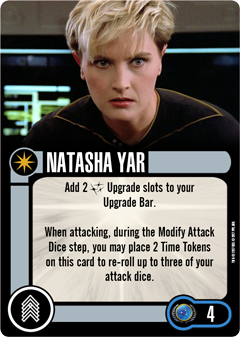
For what I have planned I really need 3 weapon slots. I have one generic and one from Scotty, so ideally I need a way of adding a third. One way I can do this in faction is using Arsenal, which takes a weapon slot and adds 2, and has a secondary ability that allows you to place time tokens on the arsenal card rather than on torpedoes. Another, is to go out of faction and take Sakonna, who adds a slot and decreases the cost of all weapons upgrades by 2SP. In order to keep penalty pure, I would also need to add the "Captured" upgrade to turn this from a Federation ship into a dual faction federation/independent ship. The option I decided on was Natasha Yar, from the Yesterday's Enterprise prize pack. Yar adds two weapon slots and has a secondary ability that adds quality. This is certainly a more expensive option than Sakonna, and it adds 2 weapon slots when I only really need one, but there is nice synergy here between Yar and Ezri, making Yar's ability a pretty good alternative to a target lock action (although admittedly only for 3 dice). It does also mean that by taking Yar I can use Scotty's extra slot as a tech slot. Also she benefits from Kirk's cost reduction ability, whilst Arsenal wouldn't. 


So now I have my extra weapon slots, what am I going to fill them with? The Excelsior-class is in a nice place by virtue of the fact that its Primary Weapon Value is 3. This means that it can take Type-8 Phasers and also Upgraded Phasers (from the Hood and Lakota respectively) taking its main 180 forward arc gun to a mighty 5, and adding a little functionality when attacking Squadrons.


My third weapon slot is to make use of that 90 degree rear arc and to do that I've chosen the new Federation Photon Torpedoes from Alliance/the Starter Set/Federation. Ideally I would have preferred the time-token versions, but I don't expect to be using them that frequently, so the 2 point version, with blanks dice converted into Battlestations, are a good choice here. 


Step 4: Efficiency

The ship already has a bit of efficiency from Tasha Yar and the blank to BS conversions on the Torpedoes, and having used a generic excelsior-class rather than a named version, I can't take the Elite Talent "Legacy of the Name" that would give a free Battle-stations action each turn. I also lack the crew slot that, if I had, i'd be using to take Seven of Nine from the Delta Flyer expansion (which maybe is an argument for taking arsenal over Natasha Yar after all). I do have two open tech slots, and after asking around, I came to Metaphasic Sweep. It is a discard, but as with the rear arc torpedoes, I don't think I'll need a free action Target Lock all that often, and being able to use it on a cloaked ship is that extra bit of utility that will serve this ship well. As it stands also, there is no "obvious" action that the ship needs to do each round so using the ship's action to Battle-stations each round won't be too onerous. 


Step Five: Finishing Touches
I have two slots left to use on this ship, a tech slot and an Elite Talent slot. I feel like I've done all I wanted, fixing the dial, and making the ship attack better, so what's left is just minor tweaks and improvements. I don't really want to spend all that many points.

My choice of Elite Talent was Calculating (from Alliance), just to boost the Captain Skill to 10 if needed. Situational, but cheap at one point.

My choice of Tech Upgrade ended up being Improved hull plating, from Alliance. This was just to make the ship a little harder to kill, for just 2 SP. 

The Final Build:
Federation Starship (Excelsior Class) [20]
- James T. Kirk 8 (Captain) (H.M.S. Bounty) [5]
- - Calculating (Alliance) [1]
- Metaphasic Sweep (Federation 'Boldly Go') [1]
- Photon Torpedoes (Alliance, 2017 Starter Set, Federation 'Boldly Go') [2]
- Montgomery Scott (H.M.S. Bounty) [3]
- - Improved Hull Plating (Alliance) [2]
- Ezri Dax (Federation 'Boldly Go') [1]
- - Natasha Yar (U.S.S. Enterprise-D) [3]
- - - Type 8 Phaser Array (U.S.S. Hood) [2]
- - - Upgraded Phasers (U.S.S. Lakota) [3]
Ship Total: 43 SP

Fleet Total: 43 SP

So I've managed to keep it Faction Pure, and under 46 Pts. I feel like a comparison to a Miranda class is unnecessary, since the Miranda couldn't get up to a PWV of 5 as easily as this version. A comparison with the Kelvin is valid though. I've spent a minimum of 2 points to get to the same PWV as a Kelvin, and I've spent 4 points on improving the dial - not including the cost of the captain (and the 2 points he saves me). A generic Kelvin come in at 24 Points, and my Excelsior, with just Type 8 Phasers and Scotty, would weigh in at 26, with Ezri an extra 2 on top of this. It's a hard sell to me to take 3 slots, a captain slot and 2 SP over what a Kelvin gives you as standard, and the Kelvin is still faster. 

But I have quite enjoyed the process of building a good Excelsior-Class ship, and I think the next time I do an in real life dials and dice STAW event, there is a high likelihood that this ship, which I've dubbed the USS Bounty, will feature in my fleet.


It is unlikely Picard will...Because I'm not Picard. 


Tuesday, 17 May 2022

Getting back on the...targ?

I ended my last post with a promise to post more often... That was August 2016.

As you can probably tell, it's been quite a while since I made a post. It's been really rather a long time since I played a game to be fair. When I was clearing out my attack wing case a couple of weeks ago I found a ship registry from January 2017... And I think that was the last event I played in, which was either Tin Man or Doomsday Machine, I can't quite remember which. 

I know that around the time I last seriously considered Star Trek Attack Wing, the card packs had just been announced, and I was vaguely aware that a Ferengi faction pack was on the way. But I didn't really pay much attention to it.

I'd recently got married, and had my first child on the way, my local venue had stopped hosting OP events and after 4 years of living and breathing STAW, I guess I was just burned out.

I didn't completely stop following STAW, I was vaguely aware of changes to generic ship costs and the rule of three, but with no regular opponents to practise for, and other games (namely Warmachine and Hordes) pressing on my time, I packed away my collection and left it in the garage.

 It was Lower Decks that piqued my interest again. Watching something that seemed so similar to the series that I'd grown up loving, yet gently humorous and slightly iconoclastic at the same time made me think about the old STAW missions and fleet building. I missed it all, and nostalgia dragged me back again.

So I went into the garage and pulled out the old STAW collection. I still had a couple of expansions new in box (Weapon Zero, IKS Amar, IRW Algeron) and a few bits of unpunched cardstock (USS Cairo) and flicking through the 6 card binders that I keep all the cards in and the memories came flooding back. 

But boy, is it difficult to find the stuff I'd missed out on! Once I'd decided I was definitely going to make an effort to start playing again, I promised myself that I wanted to be at the same position again that I'd been in before, that is to say, I owned all of the expansions and could choose from anything when I was building a fleet. I have literally everything, often in multiples, that was released between the Original Starter and wave 29. Every blind booster, every prize ship, DS9, both oversized cubes, the cloaked ship pack, GenKhan. Everything. To get back to that state again would take some effort....

From a couple of British retailers I managed to get the QVP, Gorn, Grissom and fighter squadron 6 card packs. A reseller on eBay had the new starter, the Federation, Cardassian, Vulcan, and Klingon Faction packs seemed to be still in print so I got those fairly easily, the Borg one took a little searching for, but I eventually did manage to get one reasonably coated from Germany. What I'm most interested in getting my hands in right now is the Dominion faction pack that was all Jem Hadar ships. There are a couple of line of communication open, but things that initially looked promising have fallen through. 

Then there is alliance: What a wonderful idea! I can't wait to get started on that campaign. It seems there are loads of things for me to look into and lots of new and exciting things to investigate and test. I'm very much looking forward to jumping back in with both feet,

But I'm still not Picard.

Friday, 26 August 2016

Early Game, Late Game: Part 2 - Late Game

Hi Everyone, thanks for stopping by to read this - I know it's been a while since I posted anything, and I haven't been playing quite as much STAW as I used to of late, since I've had other things going on in my life (like getting married and buying a house). I;m not holding out much hope for this post being anything like my best, so read at your own risk!

Star Trek: Attack Wing is almost equal parts list building and piloting. Certainly, some would argue that the List Building part is more important than the piloting part, since a good combo will often beat a good pilot with a bad combo. I've come into some criticism in the past since I have dismissed some cards as the refuge of a poor pilot. This got me thinking about the different phases of the game.

The Late Game:

So you've survived the initial engagement. The Thaleron weapon has fired and cost you dearly but you haven't lost the game, the opponent's Voyager has fired its Transphasic Torpedoes and fluffed, Lure has been used, Feedback pulse gone and Varel has been discarded for the last time. You are now in the late game. 

There are two challenges with building late game fleets, the first being that you have to build a fleet to actually get to the late game in the first place, and the second being that if you do get to the late game, you want to be in a position where what you have left is superior to what your opponent has left.


Image result for Transphasic Torpedoes


Actually getting to the late game is a bit of challenge since a lot of the cards that can help you to survive into the late game, like Varel and Feedback Pulse, are eventually going to be discarded and then their points are lost for the late game engagement. 

The trick is to spend your SP on cards that are going to have an effect on the game from turn one until the end of the game. One way to do so is to stack defensive buffs - evader voyager is your friend in this case - or to hold back the bulk of your fleet and sacrifice something in order to get your opponent to discard their best tricks - in which case Kor 6 is a pretty good bet. 

Ben Cheug's build for Worlds is a great example of a fleet built for the late game, since many of the discards (Quark and Cryogenic Stasis) are designed to make the fleet better at the end of the game than it was at the start.

For reference:

Resource: Officer Exchange Program (Federation/Klingon)

U.S.S. Equinox
Kor 6
Odo (Independent)
Multiadaptive Shields
Systems Upgrade
Quark: Improved Deflector Screens

I.K.S. Koraga
Kolo
Adm. Maxwell Forrest
Detonation Codes
Koss
Cryogenic Stasis: William T. Riker (Hood), Elizabeth Shelby

Kraxon
Martok (Negh'Var)
Glinn Daro

Total: 119


So, late game fleet are built to survive, to be in a better position than their opponent once they reach the late game, and to avoid discards that don't improve the fleet quality as the game goes on. I actually really like the idea of biological technology as a good late game card, but I haven't explored the uses myself.


Thanks for stopping by to read my ramblings, I'm hoping to post more often in future, also a thanks to Tucker Cobey for the write up of Worlds that gave me Ben Cheug's list.

Tuesday, 19 April 2016

Early Game, Late Game: Part 1 - Early Game

Star Trek: Attack Wing is almost equal parts list building and piloting. Certainly, some would argue that the List Building part is more important than the piloting part, since a good combo will often beat a good pilot with a bad combo. I've come into some criticism in the past since I have dismissed some cards as the refuge of a poor pilot. This got me thinking about the different phases of the game.

The Early Game:


At the start of a game of ST:AW you have all of your combos available, none of your discards have been discarded and few, if any (Jennifer Sisko withstanding) of your disables have been disabled. Certain upgrades seem somewhat less useful in the early game, since they don't really factor in until after the engagement has been made and after the initial joust has been completed. In the early game, positioning is important, as is piloting. Even if you have a killer combo, you want to make sure that you are in the perfect position to ensure that your combos go off. There are a number of cards that help to win the positioning battle in the early game that become less and less useful as the game goes on, like Lure.

Lure is currently my favourite card in the game, since it allows you to control when one of your opponent's ships enters the initial melee. I used it in one game at my last op to force one of my opponent's fleet out of formation, meaning I was only facing down 2 ships and 8 red dice instead of 3 and 12. Since my fleet was essentially 2 ships with 10 dice, the importance of being able to avoid the fire of one of those ships helped me to "win" that initial engagement in a way I wouldn't have been able to do otherwise. Lure is a quintessential early game card since it requires your opponent to be outside of range 3 when it is used. As the enemy advances towards you, the opportunity to use Lure becomes rarer and rarer. 

Another early game card is the aforementioned Jennifer Sisko (MU). In fact, Jennifer Sisko is so early game that its effects are both utilised before the game even begins. The added slot only works during fleet building, whilst the disable effect works after set up but before the first turn. Jennifer Sisko is also an interesting card that starts out as an early game card, before becoming fuel for a late game ability, a card like Sakonna or Voyager B'lanna Torres. Certain abilities, like Mirror Benjamin Sisko, allow you to discard upgrades in order to receive a bonus to attack or defence dice. Jennifer Sisko, Sakonna and Torres all have abilities that come into play in the fleet building or set up phase of the game. Once their abilities have been used they do nothing for the rest of the game, but become discard fodder (just to clarify, slots are only added at fleet building, and if the card granting the extra slot disappears later in the game, that has no effect on the slots that have been added. This also means that you can't transfer these cards to add extra slots onto a ship after the game has begun). Some of the perfect cards to discard with an ability like Mirror Sisko are cards like Jen Sisko, Sakonna and Torres (in my play-group, the act of using MU Ben Sisko to discard MU Jennifer Sisko is known as the "domestic violence" play). 

Most discards are also early game pieces - as are some disables. If you are planning to use Projected Stasis Field as a means of crippling an enemy ship in order to win the initial engagement, you aren't going to have PSF later on in the game. Similarly, using Interphase Generator to win the opening engagement means that you won't have that particular tech to deal with things that are going to happen in the late game. What cards like this do, however, and what you should consider from these cards in the early game, is allow you to be in a better position going into the late game. As an example, if you are using IG to cancel 2 hits and turn them into a single hit in round two, is that going to benefit you more than saving it for the late game? Maybe in the late game, your opponent will have an opportunity to attack you with more dice than they do in the early game (thanks to something like Biological Technology) and having an IG to stifle their plans then will be more meaningful than being able to save one hit at the early stage of the game.

This logic applies to disables too, especially when you have no easy way of recycling those discards - in my PSF build, I run a Tactical Officer (KLI) on each of my non-PSF ships, and essentially I use them as discards, since I have no way to re-enable them other than spending my action, which would be better spent on using Drex or N'Garen. Essentially, once they are used once, they are unlikely to be used again. This isn't always the case, and if you have cards like Phlox, Ogowa or the Doctor, you can re-enable those cards and use them multiple times. Consider this carefully before you do so though, as you have to ask yourself how important cards like this will be after the initial engagement. 

I should discuss briefly what I mean by "winning" the initial engagement: most fleets in the 50/3 suggested format (at 120 Sp) have either 2 50 point ships and a 20 point support ship OR 3 ships of roughly 40 points. I have seen some variations on this (50/40/30) but the two examples I've highlighted are the most frequently seen. In 90+blind, the variation is even lower, as mostly you'll see one ship at 50 and one at 40 or two at roughly 45 each. Assuming you are running the same or similar load-out, you should be looking to destroy one ship of 40-50 points in the initial pass without losing one of your own in order to be deemed a "winner". My PSF build (detailed here) works by isolating one ship to be hit by the PSF whilst my two heavy hitters can line up to destroy it. Most of the time, after PSF has disabled shields and Klingon Boarding Party has disabled all the upgrades, my opponent has between 4 and 8 hull to chew through. With the two big hitters rolling 5 dice with both re-rolls and BS conversions (one of which will be a crit) the statistics say that I'll succeed in swinging the odds in my favour. High CS is important in this situation since I want to be able to swing the odds in my favour before my opponent gets a chance to fire back at my weakened PSF carrier and swap one of their ships for one of mine. If you've PSF'd the right ship, you can avoid their incoming fire to such an extent that you should be able to survive the return fire even in your weakened state. Lure helps with this even more by moving one of their ships out of position: 3 ships, one is PSF'd and destroyed, one is Lure'd and out of position, at which point you are trading 3 of your ships' fire for one of theirs, and you "win" the initial engagement. 

There are tactics you can use to avoid this state of affairs; Movement upgrades like Forrest and In'Cha help to stop you from being out of position thanks to Lure whilst PSF can be similarly neutralised by keeping your ship at range 3 from the carrier ship. This makes cards like Quark and Tahna Los better, since if you are hiding PSF your opponent can't react to it, can't disable it with Jen Sisko and won't know that they need to stay at range 3. 

So to distil my long ramble:

  • The early game is the first 2-3 turns leading up to and including the initial engagement. 
  • A fleet built to succeed in the Early Game will "cash in" their discards and disables early on in order to ensure that they'll get a favourable result out of that initial engagement. 
  • An "Early Game Fleet" is unlikely to rely on cards whose value increases as the game goes on
  • An EGF will have high Captain Skill 
  • An EGF will want the game to end quickly, since as the game goes on, their ability to use the combos they have designed in list building will disappear.

Next time I'll take a look at the mid and late game and how you can build a fleet to thrive later on, and increase your chances of winning as time ticks away.

Thanks for reading, I'm Not Picard!

Friday, 1 April 2016

Different Ways to Play 7: the Combined Arms Build

Welcome back to my ever-longer series on different ways to play the game. I've tried to go through the different archetypes of how you can build lists to do different things:

1. High Quality Attacking
2. Defence Dice Stacking
3. Repeated Attack Cancellation
4. Multiple Movement Upgrades
5. Durability and Repairing
6. The Trick Build

The last of the series, (for now at least) is an attempt (perhaps weak and feeble) to combine counters to as many of these builds as possible into one list. It needs to be able to deal with cloaked mines and fighters, needs to be able to break combos and also to survive various tricks that someone else might pull on you. This is my attempt to do so, in mixed faction play, that I have been mulling over for a while. It isn't perfect, but it covers a lot of the builds you'll potentially be facing. I'll go through the down sides after I explain the build and how it works.


U.S.S. Hathaway [U.S.S. Hathaway] (22)
Jonathan Archer [Enterprise NX-01] (3)
Sakonna [Gavroche] (3)
Systems Upgrade [U.S.S. Hood] (2)
Second of Five [Scout Cube] (4)
Projected Stasis Field [I.K.S. Gr'oth] (6)
Unimatrix Shielding [Delta Flyer] (5)
Upgraded Phasers [U.S.S. Lakota] (1)
Type 8 Phaser Array [U.S.S. Hood] (0)
Total (46)

5/1/4/7

The Hathaway provides action economy, PWV of 5, PSF and combo breaking in the form of Second of Five. The Unimatrix Shielding makes it somewhat more survivable in general and a lot more survivable against Borg. Upgraded phasers help to deal with fighters and whilst Archer's primary role is to provide the extra crew slot, the ability to boost CS and Attack dice when needed can prove useful and gives the list flexibility.


Delta Flyer [Delta Flyer] (20)
William T. Riker [U.S.S. Hathaway] (4)
Systems Upgrade [U.S.S. Hood] (2)
B'Elanna Torres [U.S.S. Voyager] (4)
Immersion Shielding [Delta Flyer] (3)
Unimatrix Shielding [Delta Flyer] (5)
Improved Deflector Screens [Gornarus] (5)
Upgraded Phasers [U.S.S. Lakota] (3)
Type 8 Phaser Array [U.S.S. Hood] (2)
Total (48)

5/3/2/7

Bizarrely, this ship is the hard hitter of the fleet, despite being a shuttle. the Basic PWV is 3, which is added to by both Type 8 phasers and Upgraded Phasers, and 99 times out of a hundred it also benefits from Riker's ability too. Despite having 2 hull, the extra 4 shields provided by upgrades help to give it some survivability and if it becomes clear that it might just end up being in the firing line of something that ignores shields, dock with the Hathaway to avoid being targeted at all. On the defensive side, it has 3 evade dice, which is higher than average, although unlikely to be game-breaking and also Improved Deflector Screens to cancel one hit or crit per attack. 

Image result for Romulan Science Vessel

Romulan Science Vessel [R.I.S. Talvath] (12)
Mendak [I.R.W. Haakona] (4)
Adm Alidar Jarok [R.I.S. Talvath] (4)
Quark [Deep Space 9] (3)
Cloaked Mines [I.R.W. Praetus] (3 overridden to 0)
Cloaked Mines [I.R.W. Praetus] (3)
Total (26)

A classic mine layer, the RSV also has Mendak to give out BS tokens, mainly to the Delta Flyer, since it doesn't have BS natively on its action bar. I made the decision to take Admiral Jarok since I like his ability to remove opponent's target locks, but it gives the ship some flexibility in regards to Offence vs Defence. If you want to attack (since you have the CS advantage over your opponent) then use mendak to give out a BS, if not then use Jarok to rob them of their quality. You could even do both, since Jarok is a fleet action. Cloaked Mines and Quark should be relatively self-explanatory.

I haven't used a resource for this build since I was planning to use this for UK Nationals, which unfortunately I can't attend, and I wasn't sure which resources would be retired by then. You could conceivably take OXP Fed/Indy to drop the cost of Sakonna by 1 and allow you to swap out one of the captains for GenKhan or Lore, but I think the build works pretty well as is. 

The issues and weaknesses I forsee with it are basically a) Madred and b) Cloaked Mines. Madred could be used to remove one of the captains without too much trouble as I haven't got any protection against this kind of ability. As for cloaked mines, I get the feeling a good pilot shouldn't ever really worry too much about cloaked mines since a good pilot should be able to minimise their effectiveness, but if an opponent is really going to spam them, then that might just create problems for this list, having said that, the two combat ships have scan on their action bars and a lot of shields, so that could be helpful when facing mine spam lists. Finally, the ships all have what I would consider to be Low Captain Skill. Archer is at 5, Riker at 7 and Mendak at 8. Ideally they'd all be 9, since otherwise they could potentially be in a position where they can't fire since they'll be dead. 

So there you have it, the last of my different ways to play series, and the best list I could possibly come up with as a counter to all of the other different ways to play.

Comments are welcome as always


I'm not Picard!

Thursday, 31 March 2016

Different Ways to Play 6: The Trick Build

Welcome back to my irregular multi-part series on playing STAW in different ways, today I deal with perhaps my preferred way of playing, certainly for the last few OPs, the Trick Build.

Image result for Star Trek Tricks

The Basics

The trick build is often based around an upgrade that robs your opponent of his ability to attack, and often his shields too, although this isn't always the case. For me at least, the trick build is about getting an advantage in the game very quickly so as to ensure that your opponent is a ship down before the game really gets under way. It's easiest for me to explain using a build that I used to win TCW 1 and TCW 2, so some explanation on that build first before I post it (and some explanation of our weird system of house rules too.)

House Rules: When I first started playing at my current venue, the only house rules in place were a general acceptance to not go over the top, which quickly disappeared (certainly my first game was a baptism of fire when a 100 point Borg Tactical Cube came flying across a planet across the board at me turn 1 and nuked one of my ships before I even got started) but as time on we've tried to refine more and more what it is that we want from the game, leading to our current set of house rules. We have a number of experienced players on board, so we made the decision relatively early on not to retire resources, since a new player could easily borrow those resources from us if needs be, we also don't enforce the 50/3 limit, so as to distinguish our own store from others. It's surprising how much fun you can have with only a 120 point dreadnought! As well as these two rules, the other ones of note are that ship purity is enforced, with the exception of independent cards, that can go anywhere, and for the Reinforcement booster missions, we made the decision to go to 160 points (120 plus blind) to mitigate the impact of having a poor blind.

My favourite trick build, is the following:

I.K.S. T'Ong [I.K.S. T'Ong] (24)
Koloth [I.K.S. Gr'oth] (4)
Klingon Boarding Party [I.K.S. Negh'var] (5)
Projected Stasis Field [I.K.S. Gr'oth] (5)
Total (38)

I.K.S. Maht-H'A [Starter] (28)
Martok [I.K.S. Negh'var] (5)
Fleet Captain: Klingon [Fleet Captain Resource] (5)
Lure [U.S.S. Dauntless] (1)
Tactical Officer [I.K.S. T'Ong] (2)
N'Garen [I.K.S. Koraga] (4)
Total (45)

Vor'cha Class [Starter] (26)
Kor [I.K.S. Ning'tao] (5)
Tactical Officer [I.K.S. T'Ong] (2)
Drex [I.K.S. Negh'var] (4)
Total (37)
Fleet total: 120

The idea here is that you use lure to make sure that the opponent's most expensive/hardest hitting ship is in range, then you use the two additional actions that CS 10 Martok gives out to trigger first Projected Stasis Field and then Klingon Boarding Party. With the opponent's shields down, all of their upgrades disabled and unable to shoot, the two Vor'Chas then open fire with Drex/N'Garen for BS conversions and tactical officer, if needed, for re-rolls. There are problems here, since KBP doesn't work on cloaked ships, so a Romulan ship with multiple Interphase Generators may prove a hard nut to crack. I used this build to great effect against a Federation Voyager evade build, reducing it to just 4 durability and then removing all of its agility upgrades. Lure was used to ensure that it was in place for the PSF/KBP hit and then the two Vor'Chas firing at 6 dice thanks to range with great quality easily got rid of it. 

The eponymous tricks in play here are: Lure, PSF, KBP, Klingon Fleet captain and Martok. You can achieve similar without the fleet captain, but you have to change Koloth for GenKhan to ensure simultaneous movement with Martok, and it isn't nearly as reliable in this case, but still do-able and it fits into 50/3 (although not fleet/ship purity). 

Tactics:

As with most of the builds I've been cooking up for this series, this fleet is scuttled by having key aspects of it removed, such as Martok, PSF or KBP. If anything, writing this series has really opened my eyes to how important it is to have things in your build that can scalpel out key aspects of an opponent's build. It should also be noted that the trick build isn't limited to PSF combos, but could also work with Kor 6, Mirror Bashir, Breen Energy Dissipator...basically any card that messes with your opponent's fleet, either in how they can fire, how they can move or what actions they can take. The new Ceti Eel Elite Talent from Wrath of Khan's Indy Reliant prize ship is a great example of a card that can mess with your opponent's plans, and that is essentially all that the Trick Build is about, find new and interesting ways of messing with your opponent.


It's been difficult to give a full and thorough account of this way to play simply because there are so many variants of it. Certainly it is something to consider when playing, as a canny opponent with a good grasp of what to do to mess up your plans can really ruin your day! So make sure to build your fleet with PSF, Madred and Lure in mind, since not planning to deal with trick may be your undoing!


NEXT TIME: Combined Arms Builds